
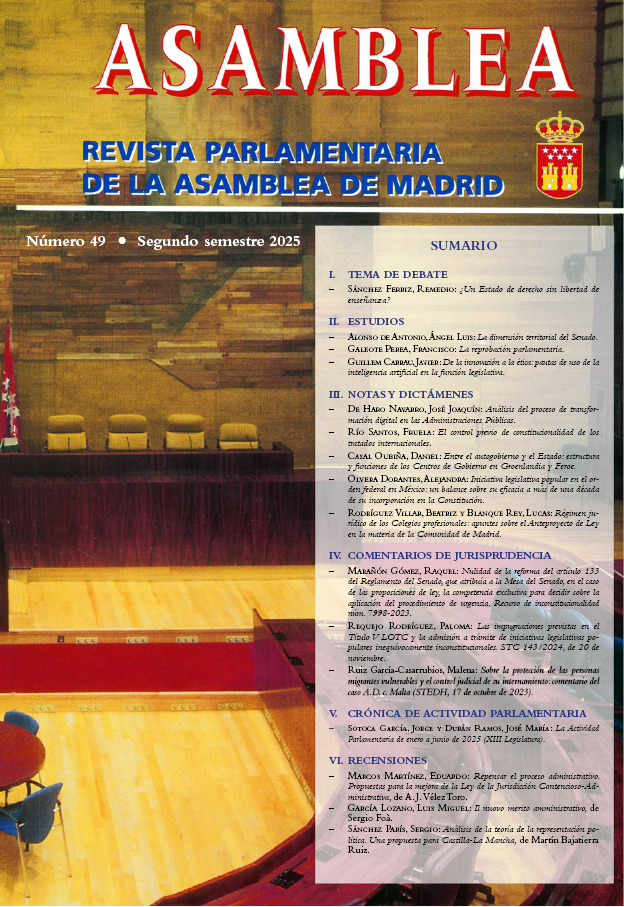
Between autonomy and statehood: Institutional design and functions of Centres of Government in Greenland and The Faroe Islands
Article Sidebar
Main Article Content
Abstract
This article analyzes the institutional design and functioning of the Centers of Government (CoG) in Greenland and the Faroe Islands, autonomous territories within the Kingdom of Denmark. Using a comparative approach, the study explores seven analytical dimensions: legal framework, formal and informal functions, institutional location, human resources, and organizational structure. Findings reveal that both CoGs reflect the Danish politico-administrative tradition through professionalized structures, led by Permanent Secretaries, and complex functional organization. Greenland demonstrates greater normative flexibility, while the Faroese structure is more rigid yet holds broad competencies. Both offices transcend the traditional advisory role by performing strategic, administrative, and intergovernmental coordination functions. The article concludes that autonomy has fostered a hybrid institutional model, combining traits of central administration with features of sovereign statehood. This research offers a replicable methodology to study subnational centers of government in advanced autonomy contexts and contributes to understanding how institutional design shapes territorial governance capacity.
Downloads
Article Details
How to Cite
Issue
Section

This work is licensed under a Creative Commons Attribution-NonCommercial-NoDerivatives 4.0 International License.
© Asamblea de Madrid. Los originales publicados son propiedad de la Asamblea de Madrid, siendo necesario citar la procedencia en cualquier reproducción parcial o total.
References
Ackren, M.(2006). «Faroe Islands. Options for indepdendence». Island Studies Journal 2:223-238.
Arenilla, M. et al. (2014). Administración 2032: Teclas para transformar la Administración Pública española. Instituto Nacional de Administración Pública.
Arenilla, M. (2017). «Cuatro décadas de modernización vs. reforma de la Administración pública en España». Methaodos Revista de Ciencias Sociales. 5(2): 302–317. http://dx.doi.org/10.17502/m.rcs.v5i2.190
Bach, T., y Thurid, H. (2023). «Policy-making in the executive triangle: a comparative perspective on ministers, advisers, and civil servants». En Handbook on Ministerial and Political Advisers, editado por R. Shaw y C. Eichbaum. Edward Elgar. https://doi.org/10.4337/9781800886582.00034
Blondel, J. (1968). «Party systems and patterns of government in western democracies». Canadian Journal of Political Science 1(2): 180-203
Cartrite, B. (2010). «Ethnopolitical Mobilization in the North Sea Region». Nationalism and Ethnic Politics. 16 (2): 240–261. https://doi.org/10.1080/13537113.2010.490759
Casal, D. y Viladrich, B. (2023). «Secesión, Autogobierno y Modelos de Democracia». Revista de Estudios Regionales 126: 149-185.
Comisión de Autogobierno de Groenlandia (2003): Report from the Self-Governance. Nutaarsiassat.
Criado Grande, I. (2009). «Organización y estructura administrativa». En Documentación sobre Gerencia Pública, VV. AA. Toledo: Escuela de Administración Regional de la Junta de Comunidades de Castilla-La Mancha.
Dale, N. W. (1998). Who Speaks for the President?: The White House Press Secretary from Cleveland to Clinton. Syracuse University Press.
Fernández Ramos, S. (2013). «Los falsos empleados públicos: el personal eventual» Revista General de Derecho Administrativo 34: 1–38.
García Luengo, J. (2022). «El personal eventual. Encuadramiento de una figura polémica en la administración local». Cuadernos de Derecho Local 60: 122–150.
Grønnow, B. (1988). «Prehistory in Permafrost: Investigations at the Saqqaq Site, Qeqertasussuk, Disco Bay, West Greenland». Journal of Danish Archaeology 7: 24–39. https://doi.org/10.1080/0108464X.1988.10589995
Gutiérrez Vicén, C. (2004). «Los ministerios y su estructura interna». Revista Parlamentaria de la Asamblea de Madrid, Extra 2: 83–180.
Harhoff, F. (1993). Rigsfællesskabet. Trepar.
Heffernan, R. (2003). «Prime Ministerial Predominance? Core Executive Politics in the UK». British Journal of Politics and International Relations 5(3): 347–372.
Howarth, D. (1957). The Sledge Patrol: A WWII Epic of Escape, Survival, and Victory. The Lyons Press.
Kudeba, N. (2014). «Norse explorers from Erik the Red to Leif Erikson». Canadian Explorers.
Laakso, M., y Taagepera, R. (1979). «Effective Number of Parties: A Measure with Application to West Europe». Comparative Political Studies 12: 3-27.
Lanzaro, Jorge. (2018). Centro Presidencial. Presidencias y Centros de Gobierno en América Latina, Estados Unidos y Europa. Tecnos.
Lijphart, A. (2016). Modelos de Democracia. Ariel.
Loukacheva, N. (2007). The Artic Promise: Legal and political autonomy of Greenland and Nunavut. University of Toronto Press.
Miller, J. (2003). The North Atlantic Front: Orkney, Shetland, Faroe, and Iceland at War. Birlinn.
Mintzberg, H. (1999). La Estructuración de las Organizaciones. Planeta.
Naalakkersuisut (2025). Selvstyrets bekendtgørelse om Forretningsorden. Naalakkersuisut Siulittaasuat.
Nebenzahl, K. (1990). Atlas of Columbus and the Great Discoveries. Rand McNally.
OCDE (2014). Centre Stage. Driving Better Policies from the Centre of Government. OECD.
Picarella, L. (2009). «Presidencialización y personalización en el sistema político español: 1975–2008». Revista Enfoques VII(11): 515–544.
Poguntke, T., y Webb, P. (2005). The Presidentialization of Power: A Comparative Study of Modern Democracies. Oxford University Press.
Ramió, C. (2016). Teoría de la Organización. Tecnos.
Rhodes, A. W., y Tiernan, A. (2014). Lessons in Governing: A Profile of Ministers’ Chiefs of Staff. Melbourne University Press.
Skou, K. R. (2007). Dansk politik A-Å: leksikon. Lindhardt og Ringhof.
Stern, P. (2004). Historical Dictionary of the Inuit. Lantham.
Thorsteinsson, J., y Rasmussen, S. (1999). Rigsfællesskabet Mellem Danmark Og Færøerne. Folketinget.
Wayling, M. G. (2004). Bloodstained Sea: the U.S. Coast Guard in the Battle of the Atlantic, 1941–1944. International Marine/McGraw-Hill.
West, H. (2024). «Faroese self-government: development over time and effects of critical junctures». The Polar Journal, 14(1), 28–47.
https://doi.org/10.1080/2154896X.2024.2342118
West, J. F. (1972). Faroe: The Emergence of a Nation. Hurst and Company.
Whipple, C. (2017). The Gatekeepers: How the White House Chiefs of Staff Define Every Presidency. Crown.